International food trade involves much more than buying and selling products. Importers and exporters also need to understand who is responsible for transportation, insurance, customs procedures, and risks during shipment. This is where Incoterms become important. Incoterms, or International Commercial Terms, are standardized trade terms used in international sales contracts. They help buyers and sellers understand their respective responsibilities, costs, and risks during the transportation of goods.
For businesses importing spices, rice, pulses, sesame seeds, herbs, dehydrated vegetables, and other agricultural products, choosing the right Incoterm can make international transactions much clearer.
In this guide, we’ll explain the most commonly used Incoterms for food export, how they work, and what buyers and exporters should consider before confirming an order.
What Are Incoterms?
Incoterms are internationally recognized rules that define certain responsibilities between buyers and sellers in a sales transaction. They help clarify:
- Who arranges transportation
- Who pays specific shipping costs
- Who handles export procedures
- Who handles import procedures
- When the risk transfers from seller to buyer
- Whether the seller needs to arrange insurance
Incoterms do not determine the price of the product itself, payment terms, ownership, or every condition of a sales contract. Instead, they mainly clarify responsibilities related to delivery, costs, and risk.
Why Are Incoterms Important in Food Export?
Food shipments often travel long distances and may involve multiple parties, including exporters, freight forwarders, shipping lines, customs authorities, warehouses, and importers.
Without clearly defined responsibilities, misunderstandings can occur.
For example, a buyer may assume that the supplier is responsible for transportation to the destination port, while the supplier may have quoted a price that only covers delivery to the origin port.
Using a clearly agreed Incoterm helps both parties understand what is included in the transaction.
Common Incoterms Used in Food Export
Several Incoterms can be used in international trade, but some are particularly common in food exports.
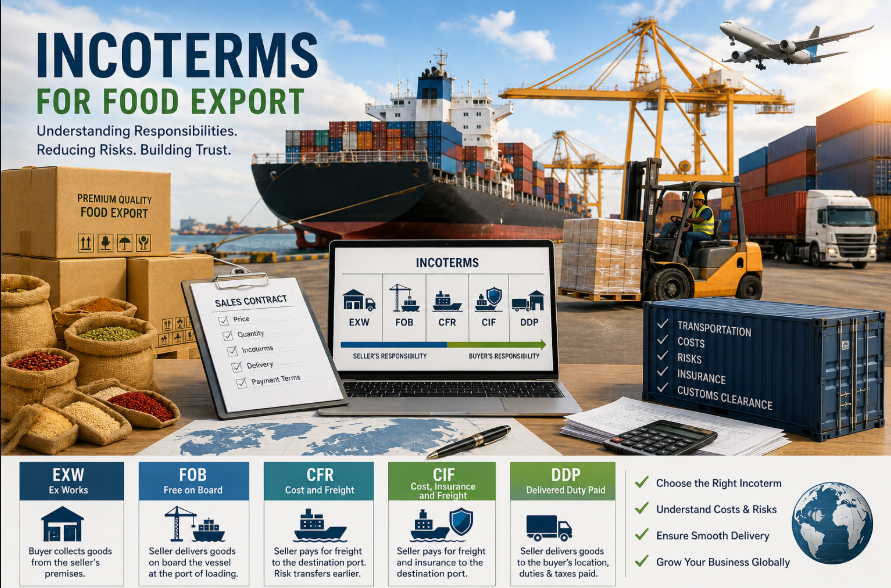
1. EXW — Ex Works
Under EXW, the seller generally makes the goods available at their premises or another agreed location. The buyer takes responsibility for most transportation arrangements from that point. This can provide the seller with fewer logistics responsibilities, but it may require the buyer to manage transportation and export-related processes. EXW can therefore be more suitable for experienced buyers who have strong logistics support.
2. FOB — Free on Board
FOB is commonly used for sea freight. Under FOB, the seller is generally responsible for getting the goods through export procedures and loading them on board the vessel at the agreed port. Once the goods are loaded on board, the risk generally transfers to the buyer. The buyer then handles the main ocean transportation and subsequent import-related arrangements. For food exporters shipping bulk products from India, FOB is often a familiar option because it provides a clear point for transferring responsibility.
3. CFR — Cost and Freight
Under CFR, the seller arranges and pays for transportation to the agreed destination port. However, the risk does not remain with the seller until the goods reach that destination. Under the rule, risk transfers at the shipment point specified by the Incoterm. This distinction between cost responsibility and risk responsibility is extremely important.
4. CIF — Cost, Insurance and Freight
CIF is similar to CFR, but the seller also arranges insurance coverage as specified under the CIF rule. The seller pays for the cost, insurance, and freight to the named destination port, while risk transfers according to the Incoterms rule rather than when the shipment physically reaches the destination. CIF can be attractive to buyers who prefer the seller to arrange the main carriage and insurance.
5. DDP — Delivered Duty Paid
Under DDP, the seller generally takes on a much larger share of the delivery responsibility. This can include transportation to the agreed destination and import clearance responsibilities, including duties and taxes where applicable. DDP can simplify the buying process for an importer, but it also places significant obligations on the seller. Both parties should carefully confirm whether the exporter can legally and practically handle the required import responsibilities in the destination country.
FOB vs CIF: What’s the Difference?
FOB and CIF are two terms that food importers commonly encounter. With FOB, the buyer generally arranges and pays for the main ocean freight after the goods are loaded on board. With CIF, the seller arranges the main carriage and insurance to the named destination port. However, buyers should not assume that CIF means the seller is responsible for everything until the goods reach their warehouse. The exact responsibilities depend on the agreed Incoterm and named place.
How Incoterms Affect Food Import Costs
The Incoterm you choose can significantly affect the final landed cost of your products. For example, the price quoted by a supplier may cover:
- Product cost
- Export packaging
- Inland transportation
- Export clearance
- Port handling
- Ocean freight
- Insurance
But not every Incoterm includes all of these costs. Before comparing supplier quotations, make sure they are based on the same Incoterm and named location. Otherwise, a lower product quotation may not actually result in a lower total import cost.
Incoterms and Risk Transfer
One of the most important things buyers should understand is that cost and risk do not always transfer at the same point. A seller may pay for transportation beyond the point where the risk has already transferred to the buyer. This is particularly important with terms such as CFR and CIF. Therefore, don’t look only at who pays the freight. Always check the exact point at which the risk transfers under the selected Incoterm.
How to Choose the Right Incoterm
There isn’t one Incoterm that is best for every food import transaction. Consider:
Your Logistics Experience
Experienced importers with established freight partners may prefer terms that give them greater control over transportation.
Destination Country
Import procedures, local regulations, and customs requirements can influence which arrangement is practical. For food businesses operating in India, applicable food safety requirements can be checked through the Food Safety and Standards Authority of India (FSSAI).
Shipment Size
The logistics requirements for a small shipment may differ significantly from those for a full container. The required MOQ (Minimum Order Quantity) can also influence the most practical shipping arrangement for a food import order.
Insurance Requirements
Consider whether insurance needs to be arranged by the seller or buyer.
Total Landed Cost
Don’t compare product prices alone. Calculate the expected total cost of getting the goods to their final destination.
Questions to Ask Your Food Export Supplier
Before confirming an international food order, ask:
- Which Incoterm is included in the quotation?
- What is the named port or delivery location?
- Which transportation costs are included?
- Who handles export clearance?
- Who arranges insurance?
- When does the risk transfer?
- Who handles import clearance?
- Are duties and taxes included?
- What additional destination charges should the buyer expect?
Buyers should also confirm whether a Certificate of Analysis (COA) is available for the relevant product batch. Getting these details confirmed before shipment can prevent unexpected costs and delays.
How Maati Farms Supports International Food Buyers
At Maati Farms, we understand that international buyers need clear communication throughout the sourcing and export process. We help businesses source Indian agricultural products including:
- Spices
- Rice
- Pulses
- Sesame seeds
- Herbs
- Dehydrated vegetables
- Edible oils
For agricultural and processed food exports from India, buyers can also explore export-related information through APEDA.
Frequently Asked Questions
What does Incoterms mean?
Incoterms are standardized international trade rules that define certain responsibilities, costs, and risks between buyers and sellers.
Which Incoterm is commonly used for food exports?
FOB and CIF are commonly encountered in sea-freight transactions, but the appropriate term depends on the buyer’s logistics capabilities, destination, and commercial arrangement.
Is CIF better than FOB?
Not necessarily. CIF can be convenient when the seller arranges freight and insurance, while FOB may give the buyer greater control over the main transportation. The right choice depends on the transaction.
Does CIF include customs duty?
Generally, CIF does not mean the seller handles the buyer’s import duties and taxes at the destination. Buyers should check the exact responsibilities under the agreed Incoterm and destination requirements.
Should Incoterms be included in the sales contract?
Yes. The agreed Incoterm and named place should be clearly stated in the commercial documentation so both parties understand their responsibilities.
Conclusion
Understanding Incoterms for food export is essential for importers and exporters involved in international food trade. Terms such as EXW, FOB, CFR, CIF, and DDP help establish who is responsible for transportation, costs, customs procedures, insurance, and risks.
However, choosing an Incoterm should not be based only on the quoted product price. Buyers should consider their logistics capabilities, destination requirements, insurance needs, and total landed cost before making a decision.
Most importantly, always confirm the Incoterm, named location, cost responsibilities, and risk-transfer point before finalizing an international food order. With clear communication and the right export partner, Incoterms can make international food sourcing more transparent, predictable, and efficient.